On this page
Write the way you talk, in short sentences you’ve read aloud, one idea at a time. That single habit fixes most of what goes wrong with video scripts. A reader can reread a long sentence; a listener can’t. So writing a script is mostly a job of cutting until every line is something you’d actually say.
The rest of the work is shaping a few sentences into a clear structure, then marking the delivery so you know exactly how to say each line.
Start with one thing you want people to do#
Before you write a word, finish this sentence: “After watching, I want people to...” That’s the job of the script. Every sentence either serves that one thing or gets cut.
You aren’t writing an essay. You’re giving someone a reason to care, a thing to know, and something to do next. If a sentence doesn’t move them toward one of those three, delete it.
Write for the ear, not the eye#
Kevin Hull’s book Sports Broadcasting puts it plainly: sentences should be short and contain only one idea each. Hull cites a suggestion of 8 to 12 words per sentence. You don’t have to count every line, but it’s a useful gut check. If a sentence runs past two breaths, split it.
A few habits that help:
- Use contractions. “We’re excited” sounds like a person. “We are excited” sounds like a press release.
- Pick everyday words. Say “buy,” not “purchase.” Say “help,” not “facilitate.” If you wouldn’t say it to a friend at lunch, rewrite it.
- Drop parenthetical asides. A listener can’t hear a bracket. Move the aside to its own sentence or cut it.
- Write numbers the way you’d say them. “Two and a half million,” not “2,500,000.”
- Say “you.” It’s warmer and more direct than “viewers” or “people.”
Give your script a shape#
Even a 30-second video needs a beginning, a middle and an end. A simple structure that works for almost any short script:
- The hook. One or two sentences that earn the next ten seconds. Say what the video is about and why it matters to the person watching.
- The body. Your point, then the proof. Three supporting points at most. One is often better.
- The close. Tell the viewer what to do next, once. Don’t repeat yourself.
This shape scales. A 60-second script is the same skeleton with a little more room in the body. A five-minute script is the same skeleton with sections.
Label the parts#
Break your script into sections with clear labels: Hook, Main point, Close, or whatever names make sense for your topic. When you read, the labels tell you where you are without eating into your word count.
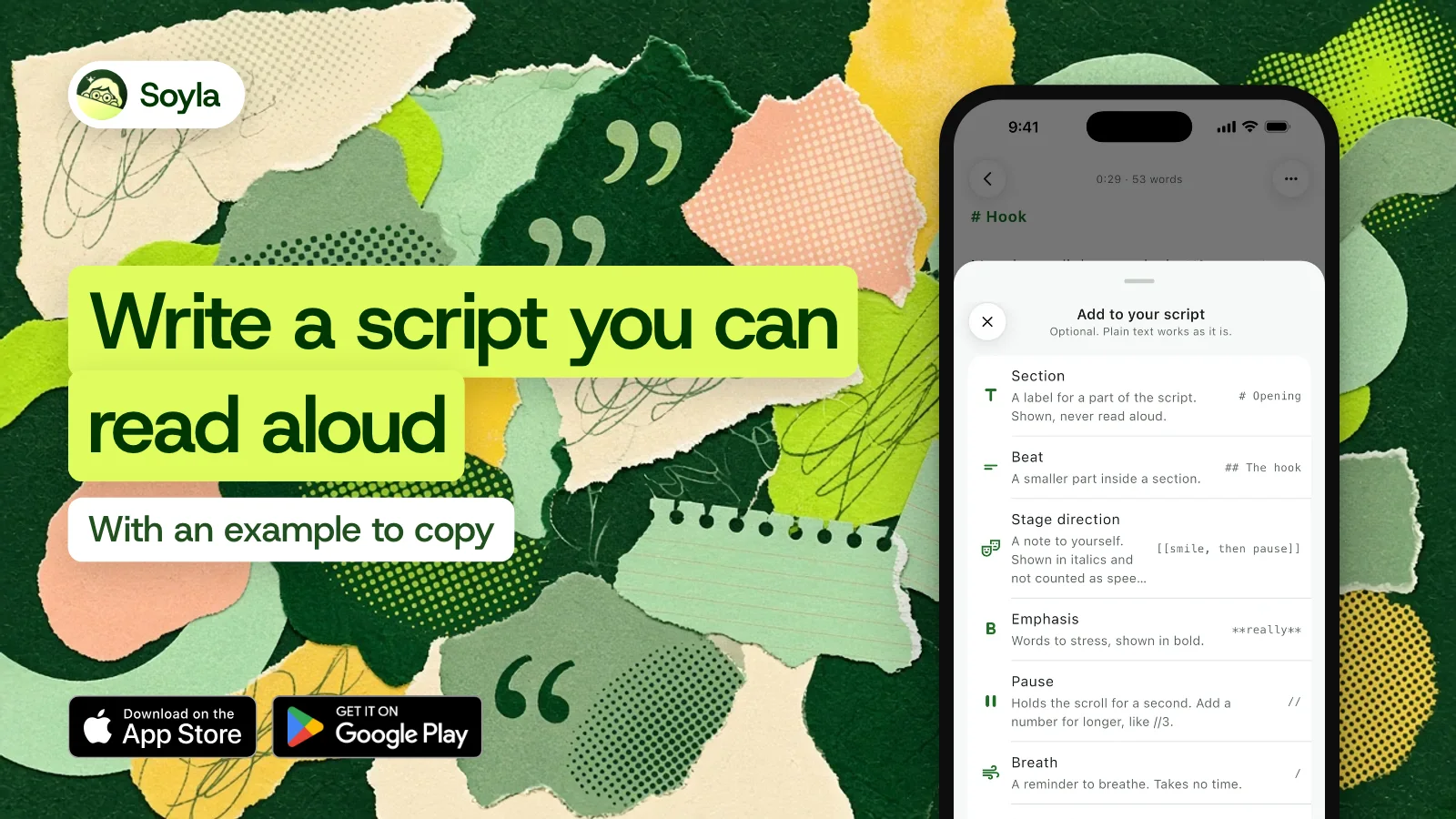
In Soyla, section labels show on screen while you’re reading but are never read aloud or counted as speech. Your speaking time updates as you write, counting only the words you’ll actually say, and a minute of speech is about 140 words.
Mark how you want to say it#
A script that only has the words is half finished. You also need to know how to say them. Go through the draft and mark:
- Pauses after the line you want to land. A beat of silence gives the viewer time to absorb your point.
- Breath marks in any sentence that still runs long.
- Emphasis on the one word per sentence that carries the meaning. Bold it. If you stress everything, you stress nothing.
- Stage directions like “smile” or “hold up the book.”
- Pronunciation notes beside any name or term you might stumble on.
In Soyla, all of these live under Add to your script. You insert them from a sheet with no syntax to learn. Plain text works fine on its own, too.

An example: 30-second yoga class intro#
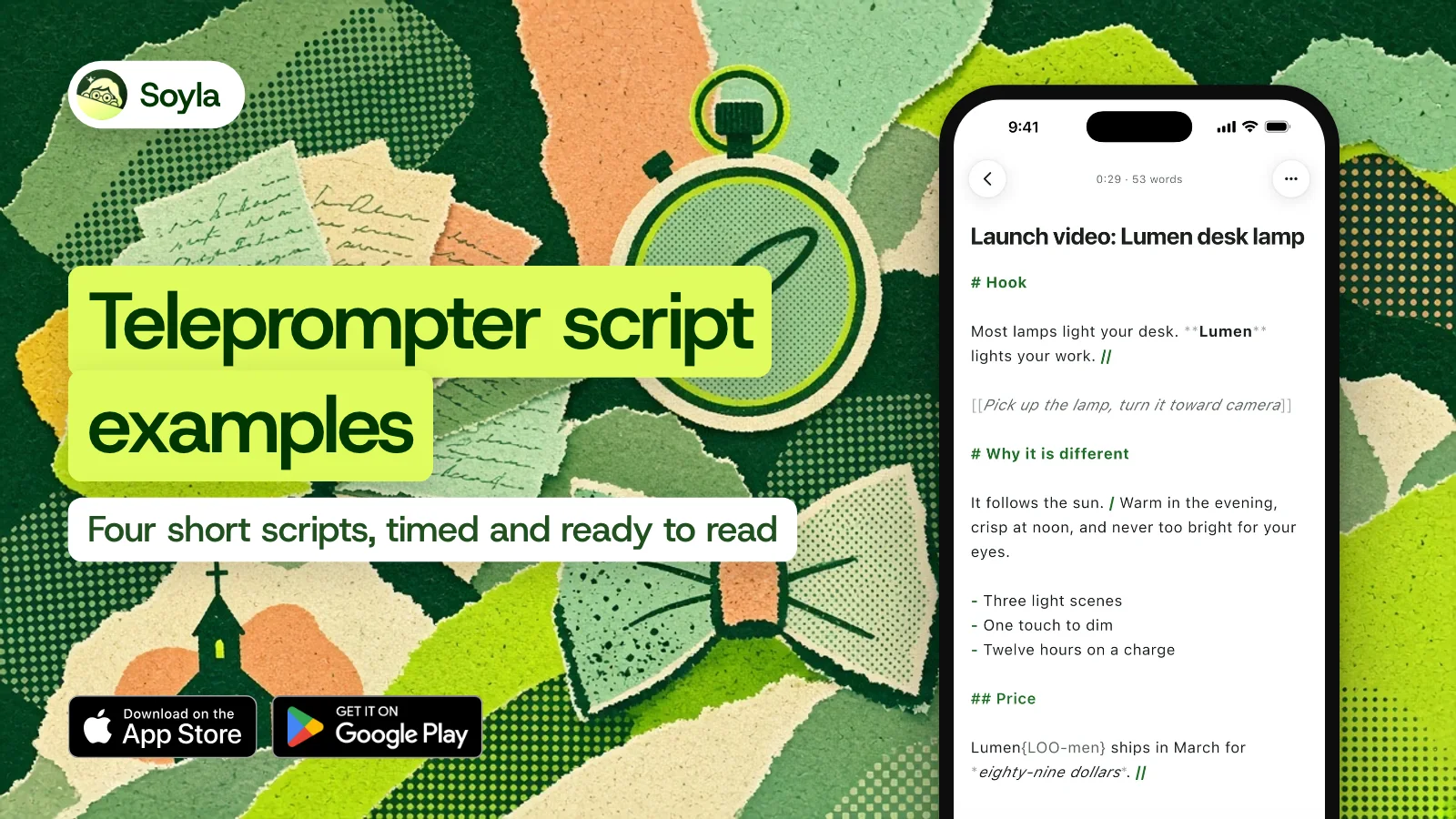
Here’s a script for a made-up yoga teacher introducing a new class on their studio’s website. It has 65 spoken words and two pauses, which at 140 words per minute, the starting pace we recommend, comes to about 30 seconds.
Hook
Your shoulders carry more tension than you think. pause
Body
This class is thirty minutes of slow, guided movement designed to release tightness in your neck, shoulders and upper back. No experience needed. You can do every pose from a chair if that feels better for you. pause
Close
I’m Priya, and I teach here at the studio. Join us Wednesday evenings at six. Sign up on our website.
smile
Notice what’s there: short sentences, one idea each, a pause after the hook, emphasis on one word in the close, and a direction at the end. Notice what isn’t: no jargon, no run-on sentences, no wasted opener like “Hey guys, welcome to my channel.”
Read it aloud, then cut#
Read the whole script out loud with a timer running. You’ll hear every line that trips your tongue and every spot where the rhythm stalls. Then cut about a tenth. Tightening is almost always an improvement.
Pay special attention to the opening. Delete lines until the very first sentence is the hook. Most first drafts bury the good stuff under a greeting or a preamble.
If you trip over the same line twice, rewrite it. The problem isn’t your reading. The problem is the words.
Test it where you’ll actually read it#
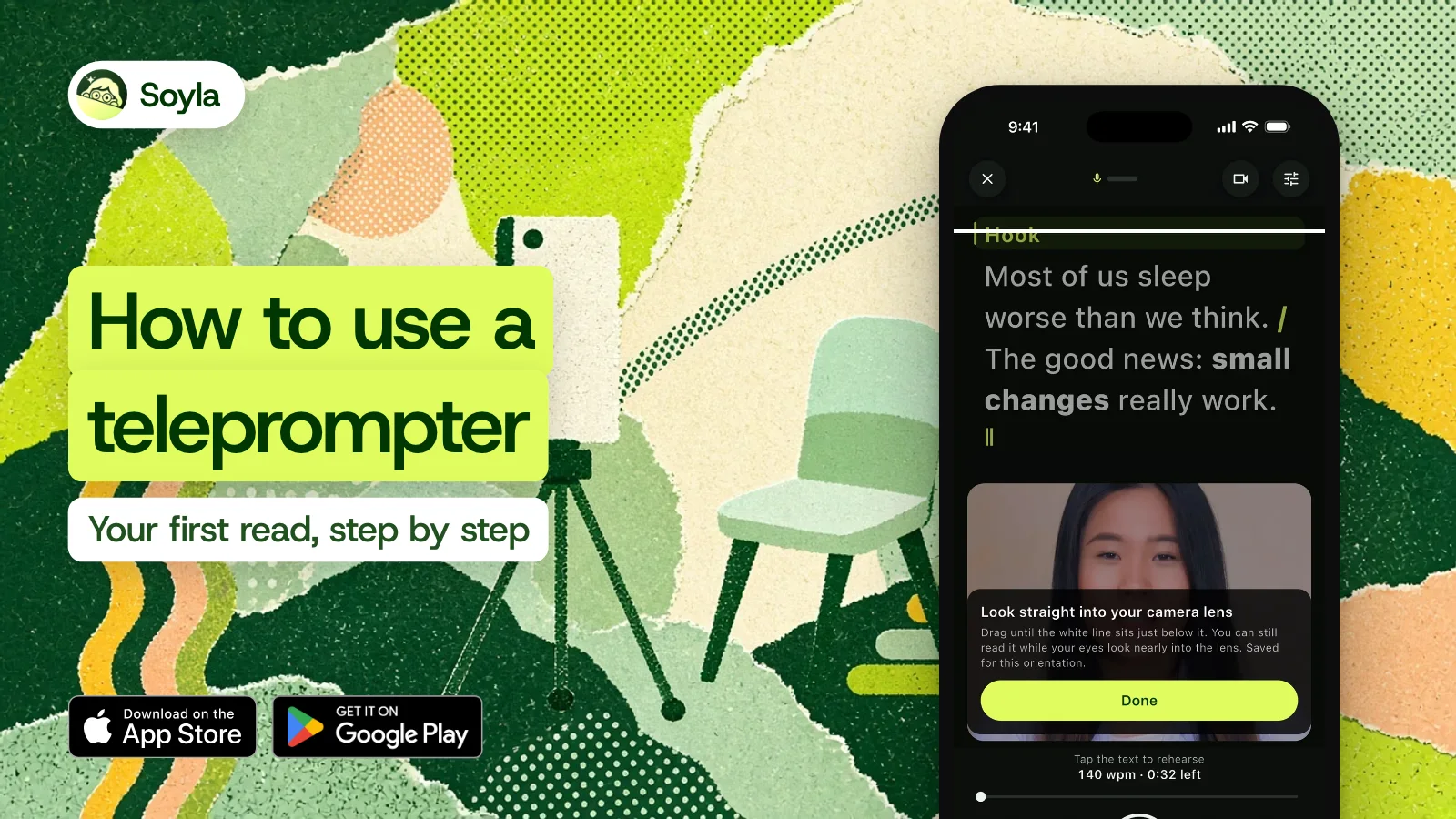
A script that sounds smooth at your desk can feel different when you read it on camera. Run it in the setup you’ll record in. In Soyla, you can rehearse with sound only and listen back, then adjust wording before a real take.
The app keeps the version you recorded each take with, so you can compare any two versions and restore one.
If you’re reading in a browser, Soyla’s free online teleprompter runs on any computer or phone with no sign-up. Paste your script, set the pace and read it through. The script stays in your browser and is never sent anywhere.
You can also check your finished script against the example scripts on the blog to see how the structure holds up at different lengths.
Frequently asked questions
How many words is a one-minute script?
About 140 words at 140 words per minute, the starting pace we recommend. If your script has several pauses, it’ll be a little shorter. The best way to check is to read the script aloud with a timer and adjust from there.
Should a video script be written in full sentences?
For most videos, yes. Full sentences give you exact wording and reliable timing. For a talk or a lesson where you want to speak more freely, bullet points can work. Either way, read the script aloud before you record so you know it fits the time.
How do I write a script that doesn’t sound read?
Write the way you’d explain the topic to a friend. Use contractions, short sentences and everyday words. Mark one emphasis per sentence so your voice has shape. Then read it aloud several times until the phrasing feels natural and you aren’t thinking about the words anymore.